
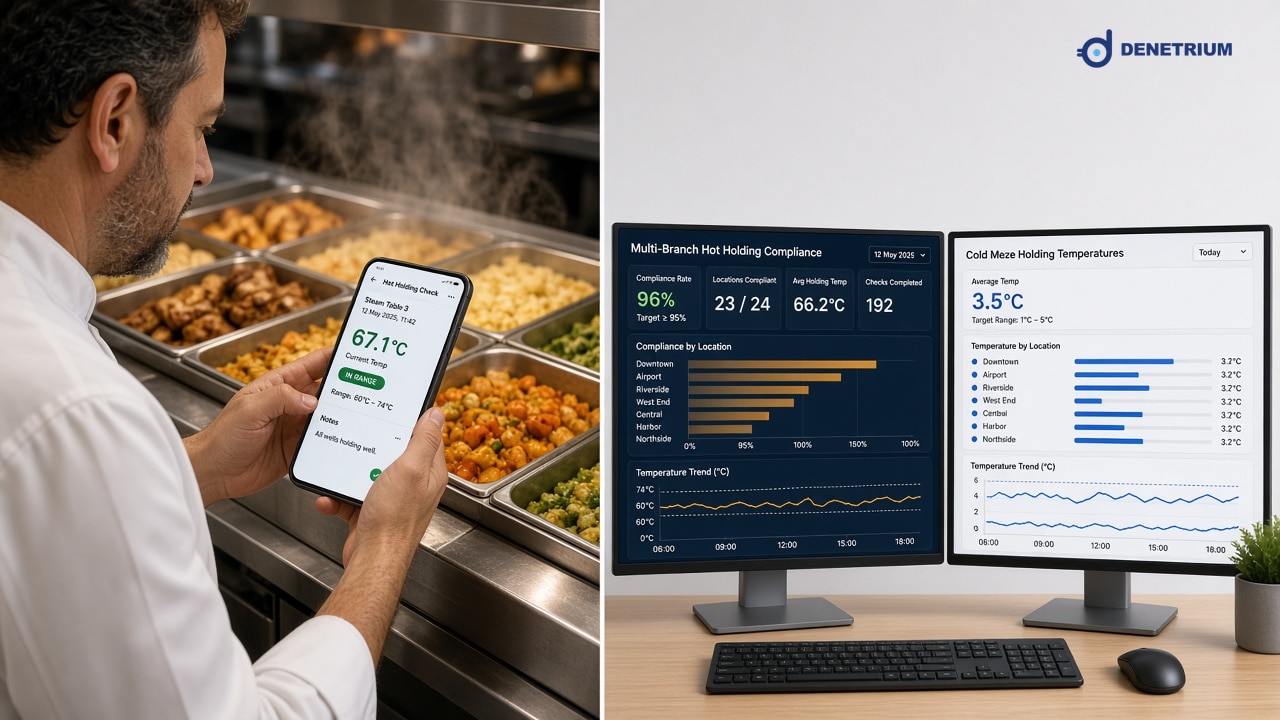
Casual-dining traditional buffet and steam-table restaurant chains operating in high-density shopping mall food courts and urban centers offer dozens of daily freshly prepared homestyle dishes, braised meats, soups, and traditional desserts. Unlike fast-food establishments where food is cooked to order, homestyle concepts prepare high volumes in bulk, holding them in hot steam tables or refrigerated display cases for hours.
This operational structure exposes the most critical food safety threshold: "The Danger Zone" (+5°C to +60°C / 41°F to 140°F).
When stew holding temperatures in a bain-marie dip below +60°C (+140°F), or when open cold yogurt meze cases climb above +4°C (+39°F), rapid bacterial multiplication begins within minutes.
Here is why manual clipboards fail high-volume buffet operations and how modern digital audit software enforces quality and food safety compliance across every location:
1. Hot Steam Table (Bain-Marie) Governance and the +65°C (+149°F) Rule
Bain-maries do not cook food; they merely maintain safe thermal holding. Evaporated well water, defective heating elements, or operators dialing down thermostats cause core temperatures to plunge rapidly.
The Operational Hazard: Soups and braised meats dropping into the tepid +50°C zone during mid-afternoon lulls, generating dangerous bacterial spores during extended holding.
The Denetrium Solution: Kitchen leads measure core temperatures across all active steam-table wells using digital probe thermometers at designated intervals (12:00, 15:00, 18:00). Any reading below +65°C (+149°F) triggers an immediate high-priority alert on the mobile audit app, requiring re-heating or immediate batch replacement.
2. Maximum Holding Dwell Times (The 4-Hour Rule)
Allowing a braised meat dish staged on the steam table at 11:00 AM to linger until late afternoon leads to skinning, dried textures, and severe microbiological degradation.
The Operational Hazard: Topping off old, depleted pans with freshly cooked batches, or extending pan staging past 6 hours to minimize food waste.
The Denetrium Solution: Shift staff log batch replenishment timestamps directly into the app. When dishes approach their maximum 4-hour window, the system prompts mandatory pan replacement, requiring photo-verified waste disposal logs.
3. Cold Meze, Yogurt Salads, and Dessert Display Refrigeration (+2°C / +4°C)
Yogurt-based appetizers, olive-oil braised vegetables, and milk puddings are exquisitely sensitive to ambient room temperatures.
The Operational Hazard: Weak display refrigeration blowers or customers leaving sneeze-guard glass shields open, causing dairy products to sour rapidly.
The Denetrium Solution: Core temperatures across refrigerated display wells are recorded digitally twice daily with photographic proof. Readings exceeding +4°C (+39°F) dispatch automated service work orders.
4. Sneeze Guard Integrity and Dedicated Utensil Discipline
In open-service buffet lines, patrons standing inches from exposed food create airborne contamination hazards.
The Denetrium Solution: District inspectors use photo-backed digital audit checklists to verify sneeze guard glass cleanliness, absence of cracks, and the strict use of dedicated serving spoons for every separate well. Cross-contact non-conformities are assigned directly to the station lead.
5. Portion Grammage and Serving Ladle Standardization
In homestyle operations, maintaining consistent meat ratios in stews and uniform starch portions directly impacts food cost and customer retention.
The Denetrium Solution: Supervisors conduct random weight audits on 3 finished portions (e.g., draining and weighing core meat chunks from stews on precision digital scales). Portion variances and excessive ladling are tracked visually on executive analytics dashboards.
Never leave food safety and brand consistency to unmonitored kitchen routines. Deploy Denetrium’s audit software and digital audit framework to enforce uncompromised safety and operational standards from the prep kitchen to the customer tray.