
The ultimate success of an audit engagement is decided long before an auditor steps foot on the facility floor. It is won or lost during the pre-audit planning and engagement stage.
Yet under legacy auditing routines, friction frequently erupts during this initial phase:
Auditors arrive unannounced or with uncoordinated schedules. Auditees push back: "We had no visibility into this visit, the required records are locked, and key personnel are on leave." Because boundary lines were never formally drawn, territorial arguments derail the review: "This control belongs to central procurement, not our branch." Valuable on-site hours dissolve into administrative friction and frantic paper searches.
Transforming audits from adversarial confrontations into collaborative governance engines requires establishing a digital framework for Audit Planning and Engagement Management.
Here is how Denetrium's specialized audit management software streamlines pre-audit preparation across 5 critical dimensions:
1. Defining Audit Objectives, Scope, and Excluded Criteria
When the boundaries of an engagement remain ambiguous, delivering an objective, defensible compliance finding is impossible.
The Denetrium Approach: Formally document the audit objectives, scope, and evaluation criteria directly within the digital engagement workspace. Crucially, explicitly define and record excluded areas or out-of-scope processes.
The audited business unit understands its exact boundaries of accountability from day one, eradicating jurisdictional debates during field testing.
2. Audit Team Allocation and Business Unit Targeting
Matching qualified auditors to specific operational environments is essential for objectivity and technical rigor.
The Denetrium Approach: Engagement leaders select target audited business units directly from the corporate hierarchy and assign the audit team (Lead Auditor, Audit Team Members, Subject Matter Specialists).
Built-in conflict-of-interest safeguards prevent auditors from evaluating units they previously managed, preserving strict audit independence.
3. Timeline Scheduling and Formal Engagement Agreement
Dictating audit schedules unilaterally generates organizational resistance. Uncoordinated calendars inevitably collapse under frontline shift pressures.
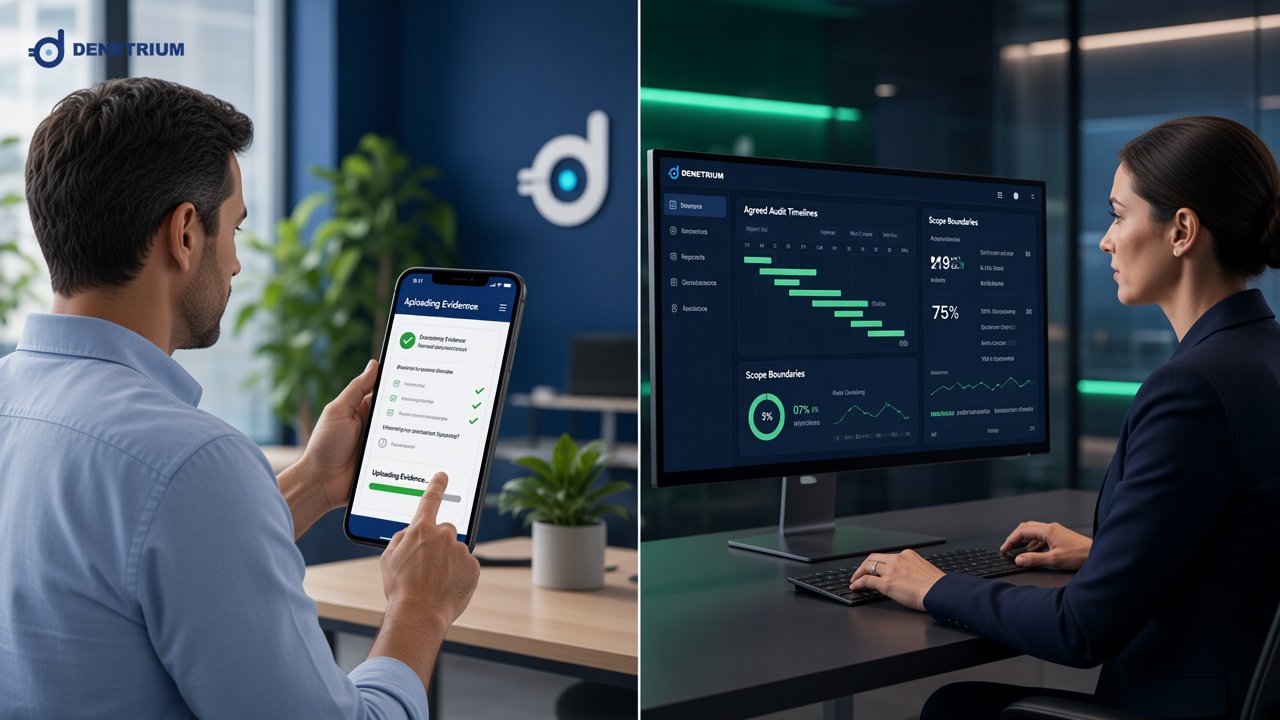
The Denetrium Approach: The lead auditor establishes an interactive engagement schedule encompassing opening meetings, fieldwork walkthroughs, sample testing windows, and closing conferences.
This schedule is routed digitally to the auditee leadership for formal sign-off. Achieving digital timeline agreement beforehand ensures operational readiness and eliminates scheduling excuses before fieldwork begins.
4. Checklist Governance and Pre-Audit Information Requests
Watching auditors wait for hours while branch staff locate paper filing folders represents an expensive drain on enterprise capacity.
The Denetrium Approach: Standardized audit questionnaires unlock for the auditee inside the platform prior to the on-site visit.
Unit leads review expectations in advance, draft preliminary disclosures, and attach digital records—such as training certificates, maintenance logs, and calibration sheets. When the audit team arrives on site, document review is already complete; field hours are dedicated exclusively to physical operational verification.
5. Integrated Engagement Communication and Consultation
Audits require an immutable, centralized channel where stakeholders document pre-audit expectations, clarifications, or temporary site constraints.
The Denetrium Approach: The built-in engagement consultation module allows auditors and auditees to attach formal commentary directly to specific scope items and questionnaire clauses. Every exchange remains permanently tied to the engagement file as an unalterable audit trail.
Stop squandering valuable audit cycles on administrative confusion and calendar conflicts. Deploy Denetrium's audit planning software and digital audit framework to establish clear operational alignment and execute high-impact inspections with complete institutional confidence.