
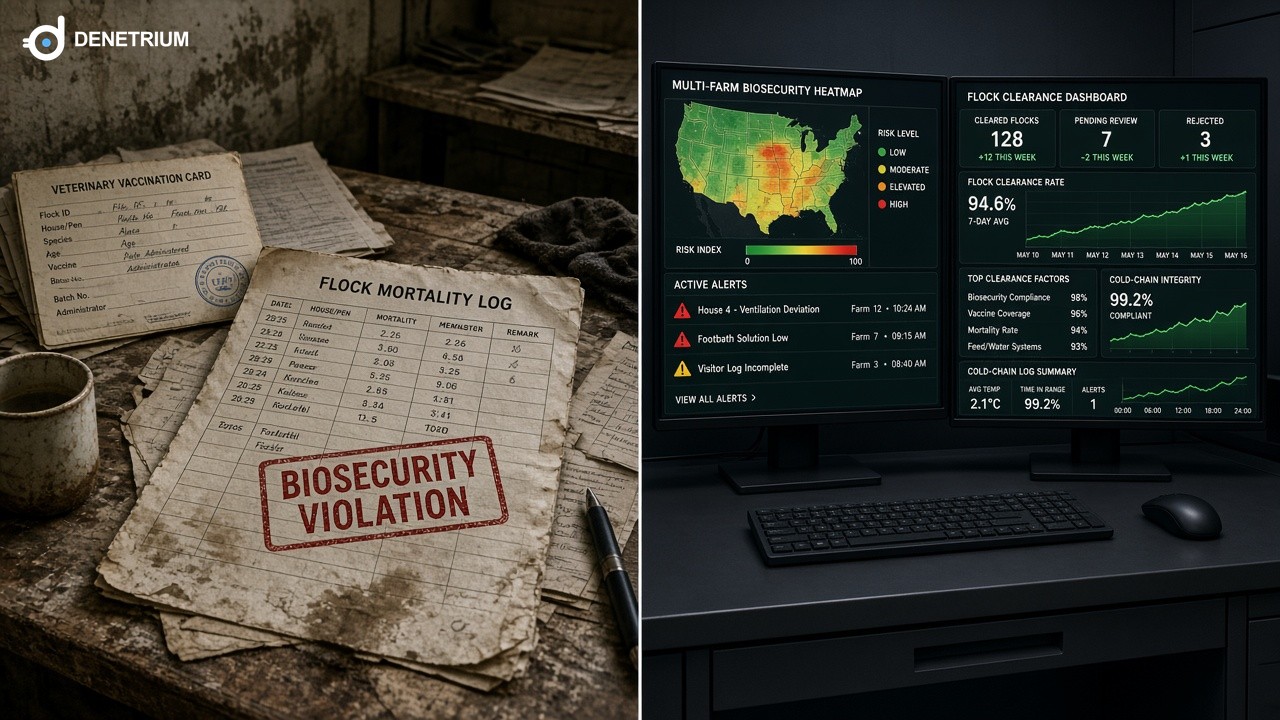
Within industrial animal protein processing (poultry, beef, and commercial table eggs), food safety never originates at the packaging belt; it is forged the precise moment chicks hatch, feed formulations blend, and livestock enters rearing sheds. The slightest gap in farm perimeter biosecurity, an unmaintained vehicle sanitization gate, or microscopic cross-contamination along the evisceration line triggers severe flock mortality (such as Avian Influenza or Salmonella outbreaks), thousands of tons in condemned product mass, export market bans, and catastrophic public health scandals.
For multinational livestock and poultry integrators, adherence to ISO 22000, FSSC 22000, BRCGS Meat, and Halal schemes dictates end-to-end operational governance connecting agricultural rearing directly to primary processing and cold-chain dispatch.
Yet as production volumes expand, manual clipboard methods introduce severe structural vulnerabilities:
Hundreds of geographically dispersed Contract Grower Farms and Feedlots are audited on loose paper forms; verifying whether field veterinarians physically inspected barns or validated footbath chemical titration is impossible,
Flock mortality logs, feed-conversion rates, and vaccination regimens remain trapped in manual barn books, keeping headquarters oblivious to disease spikes until processing begins,
Evisceration, de-feathering, and carcass chilling lines rely on unverified shift sheets for Cross-Contamination Safeguards and deep-muscle carcass core temperatures (+4°C / +39°F and below),
Table egg operations struggle to maintain systematic records for candling defect rates, eggshell sanitation, and ultraviolet (UV) disinfection arrays, allowing pathogen vectors into finished cartons,
When accredited external audit application assessors or state veterinary inspectors arrive on site, assembling multi-year flock clearances, lab swabs, and CAPA files takes weeks.
Safeguarding animal protein integrity cannot rely on water-damaged paper records or verbal assurances. Maintaining enterprise biosecurity requires a specialized digital audit software ecosystem that tracks agricultural perimeters, logs thermal chilling curves with cryptographic timestamps, and enforces closed-loop CAPA remediation.
Here is how Denetrium’s enterprise audit tracking program, online audit, and mobile audit application modernize meat and poultry operations across 5 core pillars:
1. Mobile Biosecurity Audits for Hatcheries & Contract Grower Farms
Flock health and carcass yield are dictated by operational biosecurity established during live grow-out.
The Denetrium Approach: Build dynamic mobile checklists configured for Hatcheries, Breeder Farms, and Outgrower Sheds.
Field veterinarians and inspectors audit perimeter fencing, vehicle tire wash stations, litter moisture, and rodent barriers using the native mobile audit app. Enforced GPS geofencing and live camera captures verify physical presence at the farm gate, eradicating fabricated desk evaluations.
2. Critical Control Points (CCP) and Deep-Muscle Carcass Chilling Tours
Rapid post-slaughter chilling constitutes the primary microbial hurdle preventing enterobacterial expansion within HACCP systems.
The Denetrium Approach: Spin-chillers, air-chill tunnels, deboning rooms, and cold staging docks are tagged with physical QR codes.
Internal auditors log probe thermometer readings of deep-muscle meat temperatures (+2°C / +4°C) directly alongside live photos of calibrated gauges. Out-of-spec readings automatically trigger processing line halts.
3. Cross-Contamination Controls and Sanitary Barrier Verifications
Airflow and personnel vectors between dirty zones (receiving, de-feathering) and clean zones (cutting, packaging) require strict separation.
The Denetrium Approach: Hygiene airlocks, personnel boots-in sanitizer stations, and knife sterilizer water temperatures (+82°C / 180°F rule) are monitored systematically.
Floor audits enforce strict separation protocols, generating real-time corrective tasks when protective barrier failures are observed.
4. Root-Cause CAPA Tracking for Pathogen Non-Conformities
Discovering Salmonella or Campylobacter flags in environmental swabs or carcass rinses demands immediate structural intervention.
The Denetrium Approach: Every biological non-conformity instantiates an assigned, deadline-tracked Corrective and Preventive Action (CAPA) ticket routed to technical sanitation leads.
Teams execute guided 5-Why root-cause investigations (e.g., scalder water replenishment flow rate failure vs. farm flock pathogen carrier status), implement validated countermeasures, and upload re-test lab clearance certificates before the Lead Auditor clears the ticket.
5. Multi-Location Intelligence and 365-Day Regulatory Audit Readiness
Operating multi-region integrator models with diverse hatcheries, feed mills, and processing facilities requires centralized operational visibility.
The Denetrium Approach: Biosecurity ratings, plant hygiene performance, and open CAPA resolutions consolidate into an executive dashboard.
When statutory veterinary authorities or GFSI registrars initiate surprise audits, one click exports comprehensive flock trace files and immutable audit trails, proving total operational control.
Do not leave your agribusiness brand reputation and animal welfare standards to fragile paper sheets. Deploy Denetrium’s audit software, mobile audit software, and audit tracking program to enforce total biosecurity and compliance from farm to fork.