
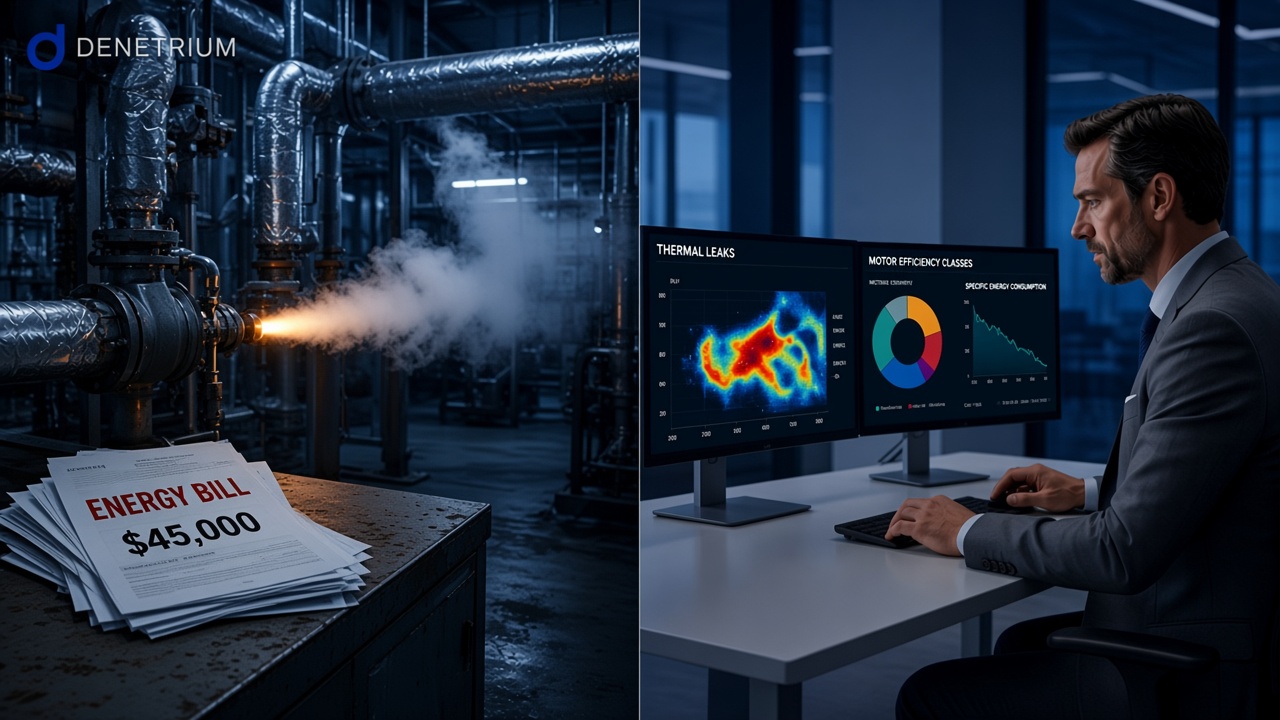
In modern industrial plants and large commercial facilities, the largest manufacturing expenditure is frequently the least scrutinized on the floor: Energy. With volatile global electricity and natural gas tariffs, paired with strict cross-border carbon border adjustment mechanisms, energy conservation is no longer an optional corporate sustainability talking point—it is a core determinant of operating margins and baseline competitiveness. The international standard governing this discipline is ISO 50001 Energy Management Systems (EnMS).
The operational core of ISO 50001 requires organizations to isolate Significant Energy Uses (SEUs), establish empirical Energy Baselines (EnBs), and continuously reduce consumption against Energy Performance Indicators (EnPIs).
Yet inside most manufacturing plants, field routines fail to match standard ambitions:
Industrial plants routinely lose 20% to 30% of their compressed air output through pipe pinholes and worn fittings; the resulting hissing noise becomes background factory noise, quietly burning millions in wasted electricity,
High-pressure steam lines and valves operate uninsulated, radiating severe thermal losses while boilers burn surplus natural gas,
Outdated IE1/IE2 electric motors run continuously without lifecycle tracking, leaving energy conservation studies trapped as static paper assessments,
When an independent external audit application or registrar arrives, engineering leads spend days retroactively collecting sub-meter logs and action item proofs across scattered local drives.
Energy waste cannot be governed from remote desks. Pinpointing line losses, enforcing scheduled walkarounds, and validating corrective maintenance requires a dedicated digital audit software ecosystem.
Here is how Denetrium’s enterprise audit tracking program, online audit, and mobile audit application modernize ISO 50001 compliance across 5 strategic pillars:
1. Dynamic Checklists Tailored to Significant Energy Uses (SEUs)
ISO 50001 does not require measuring every incidental light switch; it demands rigorous operational control over heavy consumers.
The Denetrium Approach: Build dynamic inspection protocols across compressed air systems, cooling towers, industrial furnaces, chiller plants, and steam boilers.
Map every verification point directly to ISO 50001 clauses (Clause 6.3 Energy Review, Clause 6.5 Energy Performance Indicators), transforming field inspections into empirical compliance proof.
2. QR-Linked Compressed Air and Steam Leak Mobile Audits
Compressed air is the most expensive operational utility generated in industrial manufacturing.
The Denetrium Approach: Compressed air drops, pneumatic regulators, steam manifolds, and thermodynamic traps are tagged with physical QR codes.
Field energy auditors scan the asset using the native audit application, logging ultrasonic decibel readings or thermal camera captures.
The system instantly calculates the annualized financial loss of the specific orifice size, automatically routing high-priority maintenance tickets to plant engineering.
3. Electric Motor Efficiency Classes and Insulation Integrity Verification
An uninsulated high-temperature steam valve leaks the thermal equivalent of several barrels of oil or hundreds of cubic meters of natural gas every year.
The Denetrium Approach: Field auditors verify premium motor nameplates (IE3/IE4 compliance) and thermal insulation jackets via mandatory live camera captures and timestamps.
GPS geofencing completely eliminates fabricated desk audits, certifying that the auditor was physically positioned before the boiler or motor during verification.
4. Root-Cause CAPA Tracking for Energy Baseline Deviations
When energy consumption per unit of production (kWh/ton or kWh/unit) spikes unexpectedly, leadership needs root-cause analysis.
The Denetrium Approach: Unexpected baseline deviations automatically trigger an assigned, deadline-tracked Corrective and Preventive Action (CAPA) ticket.
The engineering team must complete a guided 5-Why investigation (e.g., degraded heat exchanger plates, mechanical friction, pressure regulator drift) and submit verified post-repair telemetry before the ticket can be closed by the Energy Director.
5. 365-Day Readiness for ISO 50001 Certifications and Energy Subsidies
Eliminate administrative panic when third-party registrars, government auditors, or energy efficiency subsidy inspectors arrive at your plant.
The Denetrium Approach: Historical energy review dossiers, leak repair logs, meter calibration certifications, and workforce awareness records are encrypted and timestamped in the cloud.
Generate official ISO 50001 compliance portfolios and audit trails with one click, proving verified operational savings during internal audit and external assessments.
Stop letting operational profitability escape through leaking valves and uninsulated lines. Deploy Denetrium’s audit software, online audit engine, and audit tracking program to turn energy management into an empirical, measurable, and permanent competitive advantage.