
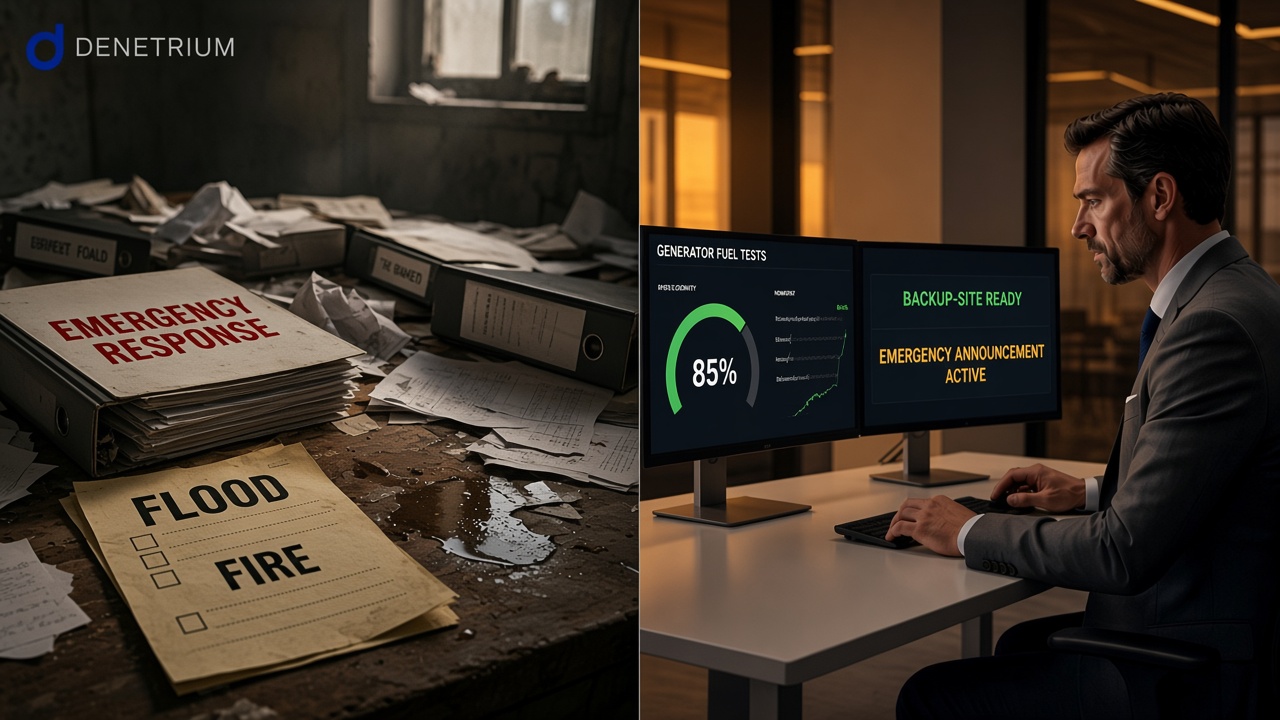
Natural disasters, regional grid blackouts, catastrophic ransomware infections, supply chain fractures, or severe industrial fires... In enterprise risk governance, the critical question is never whether an acute operational disruption will strike, but precisely when it will occur. When an unforeseen disaster forces an enterprise offline, every hour of dormancy destroys hundreds of thousands of dollars in baseline revenue, liquidates market capitalization, and inflicts irreversible brand damage. The international operational shield against such existential disruptions is the ISO 22301 Business Continuity Management System (BCMS) standard.
The core doctrine of ISO 22301 mandates that organizations map critical operational dependencies, quantify Business Impact Analysis (BIA) tolerances, establish Recovery Time Objectives (RTO) and Recovery Point Objectives (RPO), and validate secondary survival workflows.
Yet inside most corporate operations, business continuity survives merely as administrative theory:
Business Impact Analysis (BIA) dossiers gather dust in multi-tab spreadsheets updated years prior, failing to index newly integrated cloud dependencies or modern warehouse logistics hubs,
Standby generator load-bank tests, uninterruptible power supply (UPS) battery health checks, and diesel fire-pump inspections are rubber-stamped on paper clipboards; when real power grid failures hit, generators fail to crank,
Annual mandated fire evacuation drills, earthquake scenarios, or data center disaster recovery (DR) simulations exist purely as paperwork without empirical verification or headcount confirmation at muster stations,
When independent external audit application assessors or insurance risk engineers arrive, operations leads spend days locating historical drill workpapers and failover sign-offs.
Surviving an enterprise crisis cannot depend on static binders shelved in facility cabinets. Ensuring operational survivability requires an agile digital audit software ecosystem that inspects physical failover assets, documents live crisis simulations with cryptographic timestamps, and enforces immediate CAPA remediation.
Here is how Denetrium’s enterprise audit tracking program, online audit, and mobile audit application modernize ISO 22301 governance across 5 core pillars:
1. ISO 22301:2019 Dynamic Checklists Mapped to Critical Workflows
Business continuity is not about simultaneously restoring every departmental workstation; it is about sequentially orchestrating core operational survivability.
The Denetrium Approach: Build dynamic inspection catalogs across mission-critical nodes: Treasury, Core IT, Primary Manufacturing Lines, Cold Chain Logistics, and Communications.
Map ground checkpoints directly to ISO 22301 clauses (Clause 8.2 Business Impact Analysis, Clause 8.4 Business Continuity Plans), converting field audits into empirical proof for executive leadership.
2. QR-Linked Standby Generators, UPS Systems, and Utility Failover Audits
When primary utility lines sever, secondary infrastructure must fire within seconds.
The Denetrium Approach: Emergency diesel generators, battery string rooms, bulk fuel storage tanks, redundant ISP fiber conduits, and Automatic Transfer Switches (ATS) are tagged with permanent QR codes.
Field engineering auditors scan assets via the native mobile audit app, capturing live camera photos of fuel levels, voltage readings, and runtime hours under simulated load. Fabricated desk audits are eradicated through enforced GPS geofencing.
3. Timestamped Crisis Simulation and Facility Evacuation Drills
An untested continuity plan is an illusion of safety.
The Denetrium Approach: Manage live active-shooter drills, chemical leak evacuations, and data center failovers directly through the mobile interface.
Verify muster station roll calls, track evacuation clearance velocities, and log emergency system trip times with timestamped, geolocated photo evidence, instantly highlighting operational bottlenecks.
4. Root-Cause CAPA Tracking for Simulation Failures and Control Gaps
An automatic transfer switch that jams during a test drill or an off-site data backup that fails cryptographic parity represents an urgent vulnerability.
The Denetrium Approach: Every observed failure automatically instantiates an assigned, deadline-tracked Corrective and Preventive Action (CAPA) ticket.
Operational leads must complete guided 5-Why root-cause investigations (e.g., fuel contamination, transfer relay mechanical wear, workforce training deficit) and attach verified technical proof before the lead auditor grants digital sign-off.
5. 365-Day Readiness for Underwriters, Regulators, and External Audits
Eliminate the administrative scramble when third-party registrars, government emergency management authorities, or commercial insurance underwriters conduct inspections.
The Denetrium Approach: Critical vendor continuity service level agreements (SLAs), automated DR test archives, annual BIA revisions, and facility walkthrough logs sit encrypted and tamper-proof in the cloud.
Generate official ISO 22301 audit packages with one click, proving organizational resilience during internal audit and external assessments.
Do not leave your enterprise survival and brand reputation to unverified paper binders. Deploy Denetrium’s audit software, online audit engine, and audit tracking program to build an agile, battle-tested operational continuity standard across all business units.