
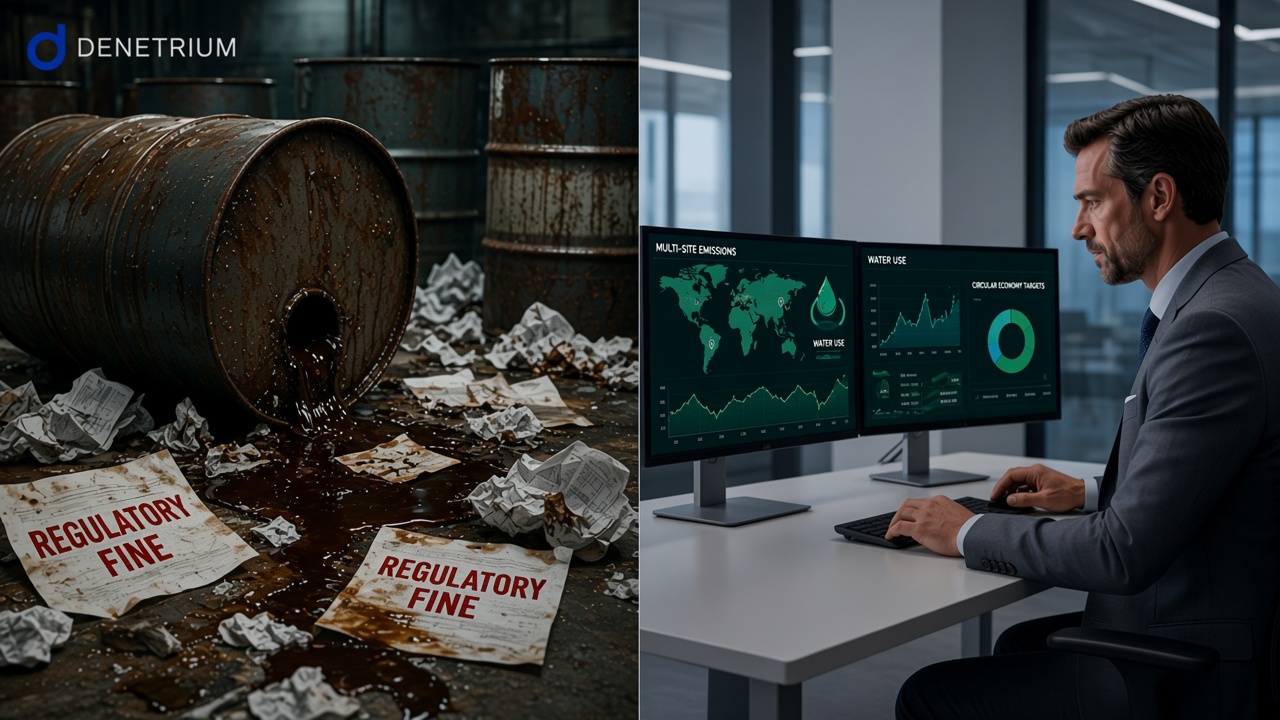
In an era dominated by the climate crisis, the EU Green Deal, and strict carbon border adjustment mechanisms, environmental governance is no longer an administrative chore aimed merely at deflecting statutory fines. It has become an essential prerequisite for market access, supply chain survival, and enterprise valuation. The global bedrock defining this operational discipline is the ISO 14001 Environmental Management System (EMS).
The core mandate of ISO 14001 is comprehensive: identify, evaluate, and systematically minimize an organization’s environmental impact across emissions to air, wastewater effluents, hazardous waste generation, and raw resource depletion.
Yet on manufacturing floors and industrial estates, compliance routines frequently fail:
Hazardous waste staging yards are inspected through backdated paper clipboards, leaving corroding chemical drums undetected until contaminants breach stormwater lines,
Emergency chemical spill response kits sit depleted of absorbent pads and neutralizers, escaping notice until an actual environmental spill occurs,
Wastewater treatment plant parameters and baghouse filtration differential pressures are tracked sporadically, exposing the enterprise to severe statutory shutdowns and criminal fines,
When independent external audit application assessors or environmental protection regulators arrive, environmental leads waste days locating paper disposal manifests and calibration certificates.
Environmental liabilities carry severe financial and reputational consequences. Maintaining continuous compliance requires a dedicated digital audit software platform that automates ground inspections, validates physical containment, and accelerates closed-loop corrective action.
Here is how Denetrium’s enterprise audit tracking program, online audit, and mobile audit application modernize ISO 14001 governance across 5 core pillars:
1. Dynamic Checklists Mapped to Environmental Aspects and Impacts
Under ISO 14001 Clause 6.1.2, organizations must systematically evaluate environmental aspects under normal, abnormal, and emergency conditions.
The Denetrium Approach: Build dynamic inspection catalogs across high-impact zones: paint booths, electroplating lines, boiler houses, and industrial effluent plants.
Map every verification point directly to ISO 14001 clauses and statutory environmental permits, turning daily shop-floor walkarounds into empirical compliance proof.
2. QR-Linked Hazardous Waste Yard and Chemical Spill Kit Verification
When an accidental chemical breach occurs, the readiness of secondary containment and emergency response equipment is critical.
The Denetrium Approach: Secondary containment pallets, blind-flange shutoff valves, emergency spill stations, and hazardous waste lockers are tagged with permanent QR codes.
Auditors scan assets on mobile inspection rounds using the native audit application, uploading mandatory live camera captures of drum labels, spill kit contents, and bund integrity. Fabricated desk audits are technically eliminated.
3. Real-Time Zero-Waste and Source-Segregation Governance
Accurate waste segregation at the point of origin drives enterprise circularity while reducing escalating waste disposal surcharges.
The Denetrium Approach: Quality and environmental officers score material sorting disciplines (wood, metal, plastic, paper, and contaminated rags) directly on facility floors.
Cross-contamination violations automatically trigger photo-documented corrective tickets assigned to production cell supervisors, driving visible improvements on the corporate zero-waste dashboard.
4. Root-Cause CAPA Tracking for Environmental Non-Conformities
A torn baghouse air filter or a saturated wastewater oil-skimmer cannot be addressed through cosmetic repairs.
The Denetrium Approach: Every observed non-conformity automatically instantiates an assigned, deadline-tracked Corrective and Preventive Action (CAPA) ticket.
The platform enforces structured 5-Why root-cause investigations. Assignees cannot close tickets without uploading fresh photographic proof of technical remediation, certified disposal manifests, or maintenance sign-offs validated by the Lead Auditor.
5. 365-Day Readiness for Statutory Regulators and External Audits
Eliminate the chaos of locating missing manifest receipts when national environmental agencies or certification bodies arrive on site.
The Denetrium Approach: Ambient emission test reports, discharge licenses, solvent management plans, and internal walkaround histories sit encrypted and timestamped in the cloud.
Generate official ISO 14001 compliance dossiers and unalterable audit trails with one click, proving your organizational environmental stewardship during internal audit and third-party assessments.
Do not leave your enterprise sustainability credentials and legal compliance to loose paper sheets. Deploy Denetrium’s audit software, online audit engine, and audit tracking program to enforce environmental operational discipline from the factory floor to the boardroom.