
While the term "audit" is frequently used as a broad catch-all in business, internal audit and external audit represent two distinct professional disciplines with fundamentally different mandates, reporting structures, and strategic outcomes.
Many growing enterprises conflate these functions or assume that contracting an annual external audit eliminates the need for ongoing internal oversight. In reality, mature enterprise governance requires both: internal audit serves as the organization’s continuous immune system and performance engine, while external audit acts as an independent seal of credibility for the market.
Here is a breakdown of the structural differences between internal and external audits, how they reinforce each other, and how digital audit software unifies both workflows:
Internal Audit vs. External Audit: Comparative Matrix
Primary Objective. Internal audit: Improve operational workflows, prevent emerging risks, and optimize processes. External audit: Independently verify that financial records or regulatory standards are accurate and compliant.
Reporting Line. Internal audit: Board of Directors, Audit Committee, and Senior Executive Leadership. External audit: External Shareholders, Regulators, Tax Authorities, Lenders, and Certifying Bodies.
Mandatory Requirement. Internal audit: Discretionary corporate governance initiative for operational excellence. External audit: Statutory requirement for publicly traded, regulated, or large enterprise entities.
Operational Scope. Internal audit: Enterprise-wide, covering frontline store operations, supply chain, EHS, IT, and internal controls. External audit: Predominantly financial statements, statutory tax compliance, or specific ISO and industry standards.
Temporal Horizon. Internal audit: Continuous, 365 days a year. Forward-looking: anticipates and mitigates future risks. External audit: Periodic, quarterly or annually. Historical: validates completed past periods and sample records.
Auditor Status. Internal audit: The organization’s internal payroll audit teams or contracted advisory specialists. External audit: Certified, licensed independent third-party audit firms with zero corporate affiliation.
1. Scope and Strategic Focus
Internal Audit: Asks: "Are our retail branches adhering to visual and safety SOPs?", "Where are our supply chain bottlenecks?", "What emerging compliance risks could disrupt Q4 performance?" It penetrates every operational layer of the company.
External Audit: Asks: "Do these financial disclosures fairly reflect material reality?", "Did the facility operate within environmental and labor legal frameworks?", "Does the quality system meet ISO 9001 clauses?"
2. Cadence and Operational Rhythm
Internal Audit: Functions as an ongoing operational cycle. Store units, cold-storage warehouses, and manufacturing lines undergo weekly, monthly, or score-triggered reviews, with Corrective and Preventive Actions (CAPA) tracked to physical closure.
External Audit: Functions as an annual or semi-annual formal intervention, relying on statistical sampling to validate historical accuracy.
3. Audiences and Actionability
Internal Audit Deliverables: Internal, operational action blueprints delivered directly to process owners and executive leadership to drive measurable remediation.
External Audit Deliverables: Formal public opinions, assurance letters, and certification seals distributed to banks, institutional investors, and regulatory bodies.
How Internal Audits Power External Audit Success
An enterprise operating a rigorous internal audit framework navigates external audits with zero operational friction and zero surprises.
When a company continuously monitors store standards, resolves operational defects through verified photographic evidence, and maintains immutable digital logs throughout the year, external surveyors face zero data gaps. Internal audit provides the factual baseline that guarantees smooth external compliance.
Unifying Internal and External Audits with Denetrium
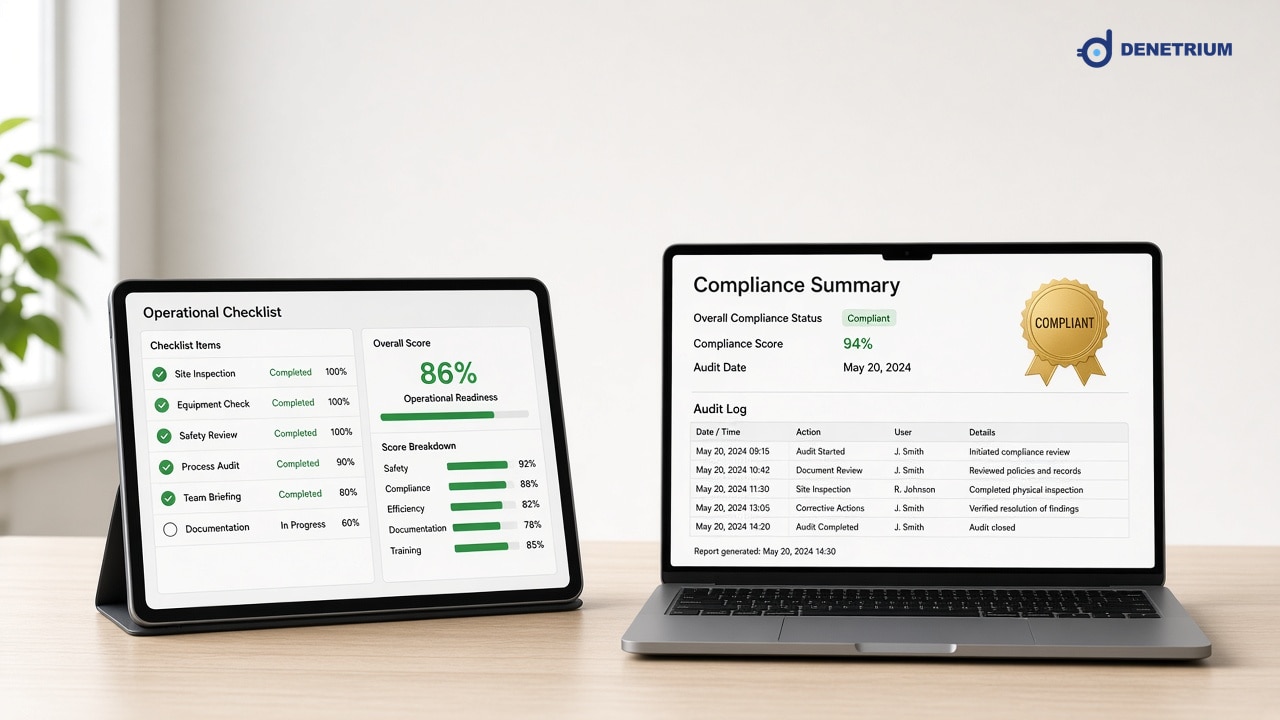
Denetrium delivers a centralized cloud platform capable of managing continuous internal operations alongside independent third-party engagements:
For Internal Audit Teams: No-code dynamic checklist builders, GPS-verified mobile field walkthroughs, automated management dossiers, and a closed-loop CAPA engine.
Secure Access for External Auditors: Granular Role-Based Access Control (RBAC) allows administrators to provision time-bounded, restricted access to independent third-party auditors exclusively for designated scopes.
Instant Audit Trail Retrieval: Historical inspections, timestamped photographic proof, and remediation workflows export into standardized executive compliance files with one click.
Transform your internal audit function into an engine of operational excellence while maintaining 365-day external audit readiness. Deploy Denetrium’s digital audit software and online audit platform to master governance across every facility.