
In a modern hospital or multi-campus healthcare network, clinical audit and quality governance carry stakes unlike any other commercial enterprise: human life and patient safety.
A single missed hand hygiene compliance step before a sterile field, an unmonitored vaccine refrigerator climbing above +8°C (+46°F), a missed chemical sterilization indicator in the central sterile processing department (CSPD), or mismanaged clinical biohazard waste exposes healthcare systems to devastating hospital-acquired infections (HAIs), malpractice liabilities, and the suspension of operating licenses.
Yet across leading hospitals, internal clinical evaluations and preparation for international Joint Commission International (JCI) accreditations frequently depend on paper clipboards hanging behind doors, misplaced archival folders, and frantic last-minute spreadsheet consolidation before surveyor visits.
In healthcare environments where unaddressed non-conformities yield life-threatening outcomes, here is how Denetrium’s dedicated audit software and digital audit platform enforce clinical consistency across 4 critical pillars:
1. 100% Traceability in SKS and JCI Self-Assessment Audits
Accredited healthcare institutions must execute ongoing clinical self-assessments to verify compliance with International Patient Safety Goals (IPSGs) and statutory healthcare quality frameworks.
The Operational Hazard: Self-assessment data from emergency departments, surgical suites, clinical laboratories, and imaging units are compiled in manual spreadsheets over weeks, allowing acute clinical liabilities to remain buried inside averages.
The Denetrium Approach: Quality Directorates link statutory indicators to standardized periodic inspection cycles. Committee members and clinical auditors complete guided walkthroughs on mobile tablets. The instant an evaluation wraps up, unit-level compliance indexes and enterprise accreditation readiness scores populate the command dashboard in real time.
2. Infection Prevention and Control (IPC) in Surgical and ICU Environments
Healthcare-associated infections (HAIs) remain modern medicine’s most persistent and expensive operational challenge.
The Operational Hazard: Hand hygiene compliance monitoring and environmental terminal cleaning checklists are signed off retroactively from memory, allowing pathogens to spread silently between isolation rooms and intensive care wards.
The Denetrium Approach: Infection control practitioners and clinical auditors conduct mobile walkthroughs backed by geotags and timestamps. Surface disinfections, biohazard waste bin protocols, and sterilization pouch verification photos are logged directly into the system, producing tamper-proof frontline evidence.
3. Biological Cold Chain: Vaccines, Blood Banks, and Pharmacy Storage (+2°C to +8°C)
Biologics, temperature-sensitive vaccines, and blood products require uncompromising storage within +2°C to +8°C (+36°F to +46°F). Temperature excursions permanently compromise potency and therapeutic safety.
The Operational Hazard: Scribbling arbitrary "+4°C" entries onto paper clipboards conceals overnight compressor failures and door gasket leaks.
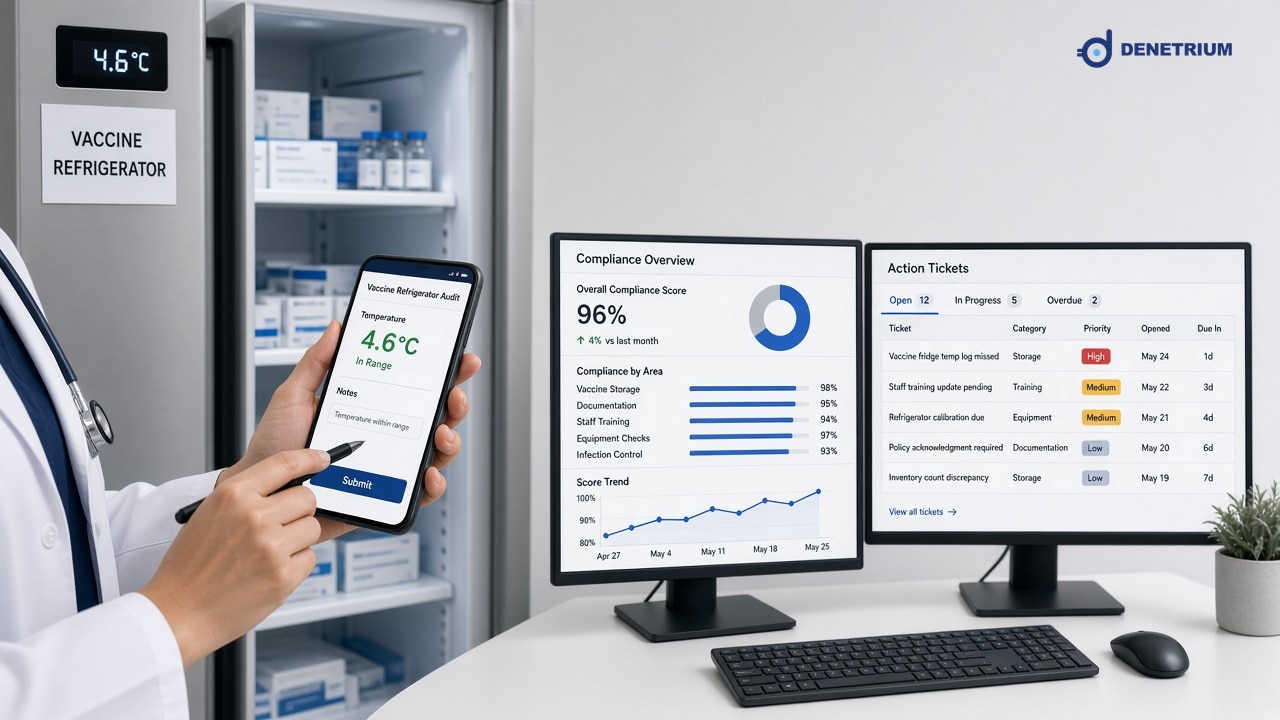
The Denetrium Approach: Shift nurses and pharmacy leads record core storage temperatures and ambient humidity levels via the mobile audit app. Any thermal excursion outside validated tolerances immediately triggers an automated high-severity Corrective and Preventive Action (CAPA) ticket sent simultaneously to the lead pharmacist, facility engineering, and the Quality Director.
4. Inpatient Rooms, Support Services, and Environmental Hospitality
Beyond core clinical medicine, patient room hygiene, linen change protocols, nurse call button functionality, and dietary meal tray timing dictate patient satisfaction and Net Promoter Scores (NPS).
The Denetrium Approach: Environmental services (EVS) leads audit inpatient units using structured digital forms. Defective motorized beds, broken call systems, or sanitary plumbing faults instantly spawn automated maintenance work orders, ensuring physical repairs occur before the room is assigned to the next patient.
5. Eradicating Orphaned Non-Conformities and Stalled CAPAs
Identifying an infraction during an internal clinical round is only half the battle; the legal and clinical obligation is demonstrating verified resolution.
The Denetrium Approach: Every flagged clinical defect is routed directly to the designated department head with an immutable timestamp and assigned completion deadline. Tasks cannot be closed without photographic evidence and supervisor sign-off. Chief Medical Officers (CMOs) monitor open, pending, and overdue clinical action items on a centralized executive screen.
Do not leave patient safety and regulatory accreditation to unverified paper binders. Deploy Denetrium’s audit software and digital audit platform to transform clinical quality governance into an audit-ready, zero-harm operational engine.