
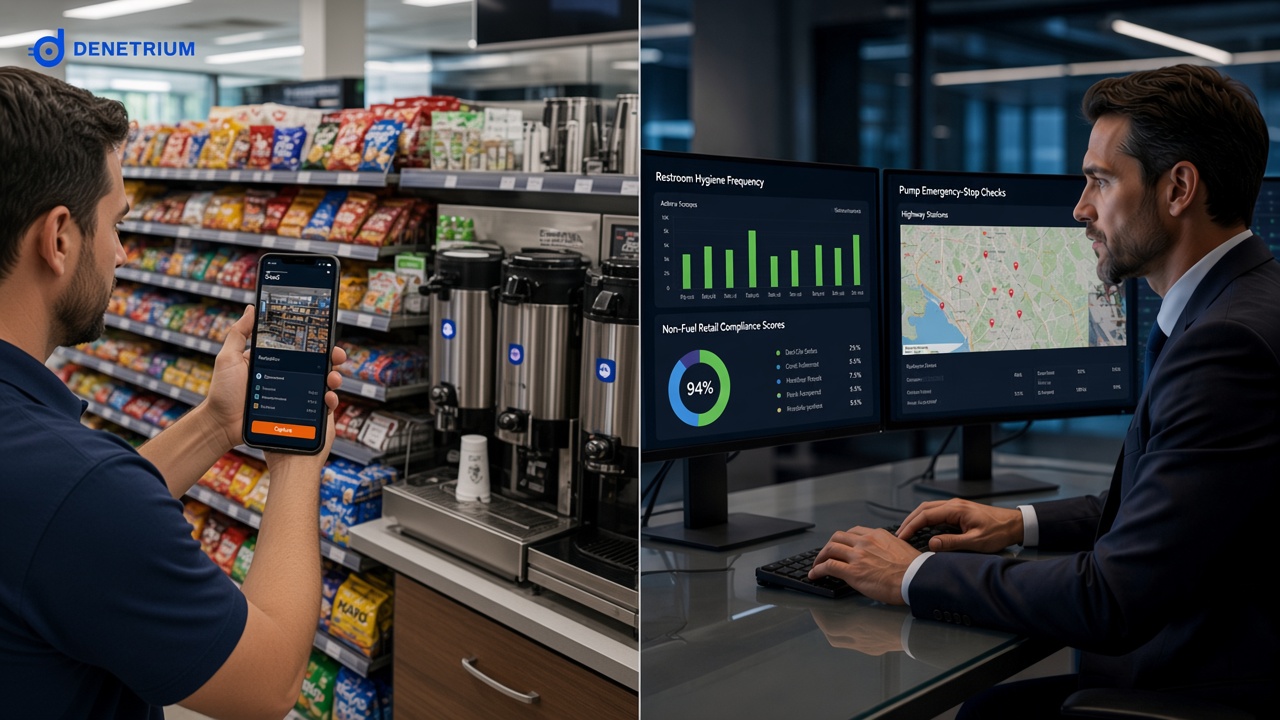
In modern fuel retailing, commercial competitive advantage is no longer determined solely by fuel pump prices. For today’s mobile consumer, a highway service station is far more than a refueling depot—it is an integrated retail, dining, and travel hospitality destination.
Consumer research consistently confirms that the single most influential factor driving a motorist’s choice of service plaza is restroom cleanliness. A customer reassured by spotless sanitary facilities naturally transitions into the convenience store, where planogrammed shelves drive high-margin Non-Fuel Retail (NFR) impulse purchases. Conversely, a foul-smelling restroom, missing price tags, or an oily, unkempt forecourt will instantly destroy brand loyalty.
Governing these complex retail and operational standards across hundreds of franchised dealer locations using periodic supervisor visits or static paper logs creates massive blind spots.
Here is how Denetrium’s dedicated audit software and mobile audit platform enforce operational consistency and maximize non-fuel retail margins across 5 core pillars:
1. Restroom Hygiene as a Commercial Magnet: Verifiable Hourly Audits
Sanitary cleanliness is the direct proxy for fuel brand quality in the consumer’s mind. A restroom cleaned once at dawn rapidly deteriorates under heavy highway traffic.
The Ground Reality: Depleted soap and paper dispensers, broken door latches, persistent odors, and employees signing off paper clipboards hours in advance without inspecting the stalls.
The Denetrium Approach: Station janitorial staff and shift leads initiate hourly restroom walkthroughs by scanning dedicated QR codes inside each cubicle. Mirror clarity, floor dryness, soap levels, and odor control are verified with photographic timestamps. Any failure immediately triggers an automated task assigned to the shift lead.
2. Convenience Store Planograms and Impulse Queue Merchandising
The convenience store represents the engine of non-fuel retail profitability. Corporate supplier contracts involving premium eye-level placement and cold-vault slotting must be strictly protected on the floor.
The Ground Reality: Franchisees allowing rogue local products to encroach upon contracted brand facings, unstocked promo displays, or uncalibrated beverage chillers running warm.
The Denetrium Approach: Territory managers and mystery shoppers compare live shelves directly against master corporate planogram reference images inside the mobile app. Display violations, promotional shelf-talker absences, or expiring inventory trigger photo-backed corrective actions sent directly to the station manager.
3. Foodservice & Fresh Coffee Quality Standards
High-margin specialty coffee and fresh bakery offerings are critical retention drivers for long-distance highway travelers.
The Ground Reality: Skipped daily chemical milk-line cleaning cycles on espresso machines, dried pastries staged past their dwell times, or empty consumable stations (lids, sleeves, napkins).
The Denetrium Approach: Opening shift checklists enforce photo-verified espresso machine cleanings, milk refrigerator temperature logs (+4°C / 39°F), and fresh-bake display shelf-life limits, ensuring food safety and consistent beverage quality.
4. Forecourt Aesthetics, Dispenser Maintenance, and Customer Protocol
The forecourt is the primary physical touchpoint where brand impressions are established.
The Ground Reality: Oil slicks and diesel spills pooling around pump bases, cracked nozzles, broken windshield-washing fluid stations, and attendants failing to deliver branded greeting scripts.
The Denetrium Approach: Pump island cleanliness, windshield bucket solution freshness, canopy illumination, staff grooming, and service greeting etiquette are scored systematically during visits. Mechanical defects route directly to facilities maintenance.
5. Hazardous Material Forecourt Safety and Emergency Systems
Handling volatile hydrocarbons and LPG requires uncompromised operational vigilance.
The Ground Reality: Emergency fuel shutoff switches (ESD) obstructed by retail inventory or advertising banners, severed electrostatic grounding clamps, or depressurized fire extinguishers sitting on pump islands.
The Denetrium Approach: Field auditors verify ESD clear zones, grounding wire continuity, and dispenser fire extinguishers via mandatory live camera captures and barcode scans. Geofencing guarantees inspectors are physically on site, eliminating phantom audits.
Do not surrender your retail margins and brand reputation to inconsistent frontline execution. Deploy Denetrium’s audit software, mobile audit, and digital audit framework to enforce spotless customer facilities and rigorous retail discipline across your entire service station network.