
Fashion and apparel retail is an emotional, high-velocity business where aesthetic execution drives direct conversion. Corporate visual merchandising (VM) teams and creative directors spend months designing new seasonal campaigns, window display narratives, mannequin styling, and precision fold-and-hang planograms.
Yet once hundreds of pages of lookbooks and VM guidelines land at individual stores, operational execution fractures:
Did the flagship branch dress the front mannequins correctly?
Are promo tables folded to spec with accurate size gradient curves?
Is the fitting room—the exact friction point where buying decisions are sealed—clean, impeccably lit, and clutter-free?
Attempting to govern a multi-store fashion network through unorganized messaging app photos or static paper checklists leaves your brand vision at the mercy of individual store associates.
Here is how Denetrium’s dedicated audit software and digital audit platform bring operational rigor and flawless visual compliance across every storefront:
1. Instant Alignment with Visual Merchandising (VM) Guidelines
During seasonal launches or clearance campaigns, executing visual resets simultaneously across all stores dictates foot traffic.
The Ground Reality: Store managers upload fragmented photos to chat groups. Important styling errors, incorrect accessory placements, and poor lighting angles become lost in the notification noise.
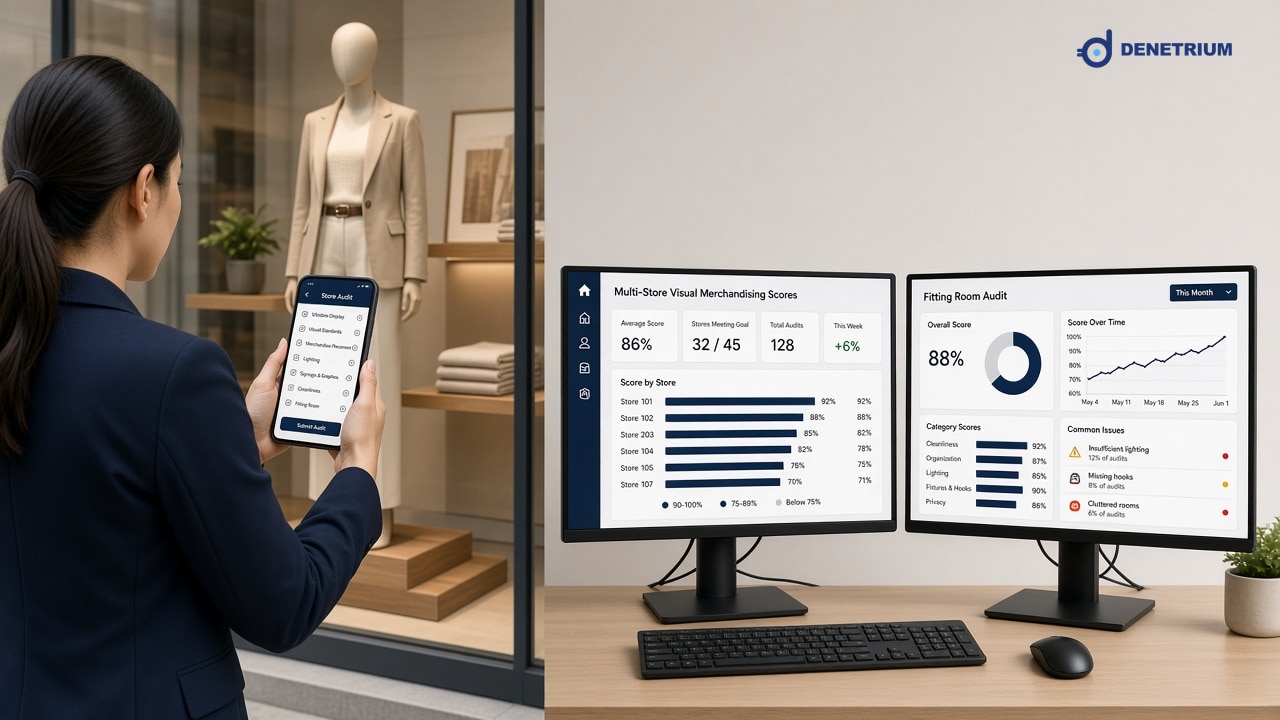
The Denetrium Approach: Field VM supervisors and store leads execute guided visual checklists. The mobile app displays the master corporate reference photo directly beside the camera viewfinder, enabling instant side-by-side verification. Any non-conforming display spawns an automated remediation task.
2. Fitting Room Experience, Lighting, and Housekeeping
The fitting room is where the commercial transaction succeeds or fails.
The Ground Reality: Accumulations of discarded hangers, dusty mirror surfaces, blown spotlights, and garments left on floors drive shoppers away without buying.
The Denetrium Approach: Shift routines enforce scheduled fitting room checks verifying mirror clarity, fragrance standards, lighting lux levels, and stall cleanliness. Deficiencies dispatch real-time corrective actions directly to floor associates.
3. Loss Prevention (LP) and EAS Anti-Theft Security
Inventory shrinkage remains one of the largest unmonitored margin drains in fashion retail.
The Ground Reality: Malfunctioning Electronic Article Surveillance (EAS) pedestals at entrance doors, missing hard tags on high-theft outerwear, and emergency exits obstructed by cardboard cartons.
The Denetrium Approach: Periodic LP checklists require photo-verified testing of EAS gate signals, camera sightlines, and high-value product tagging compliance, eliminating compliance blind spots before they turn into inventory shrinkage.
4. Back-of-House Organization, Stock Replenishment, and EHS
When a shopper cannot find their size on the sales floor, the sale is lost—even though the unit often sits buried inside an unorganized backroom carton.
The Denetrium Approach: Hanging stock organization, carton stack heights, sorting velocity, and emergency pathway clearances are audited using mobile forms, accelerating sales floor replenishment and ensuring workplace safety.
5. Complete Network Campaign Tracking from a Single Cockpit
Knowing whether all 150 nationwide branches launched the mid-season promotion simultaneously no longer requires days of phone calls.
The Denetrium Approach: Corporate Retail Directors track campaign adoption live on the executive dashboard, pinpointing exactly which stores completed their visual resets and which branches lag behind.
Do not let creative vision get diluted on the retail floor. Deploy Denetrium’s digital audit software and mobile audit tools to enforce uncompromising brand consistency from the window display to the fitting room across every location.