
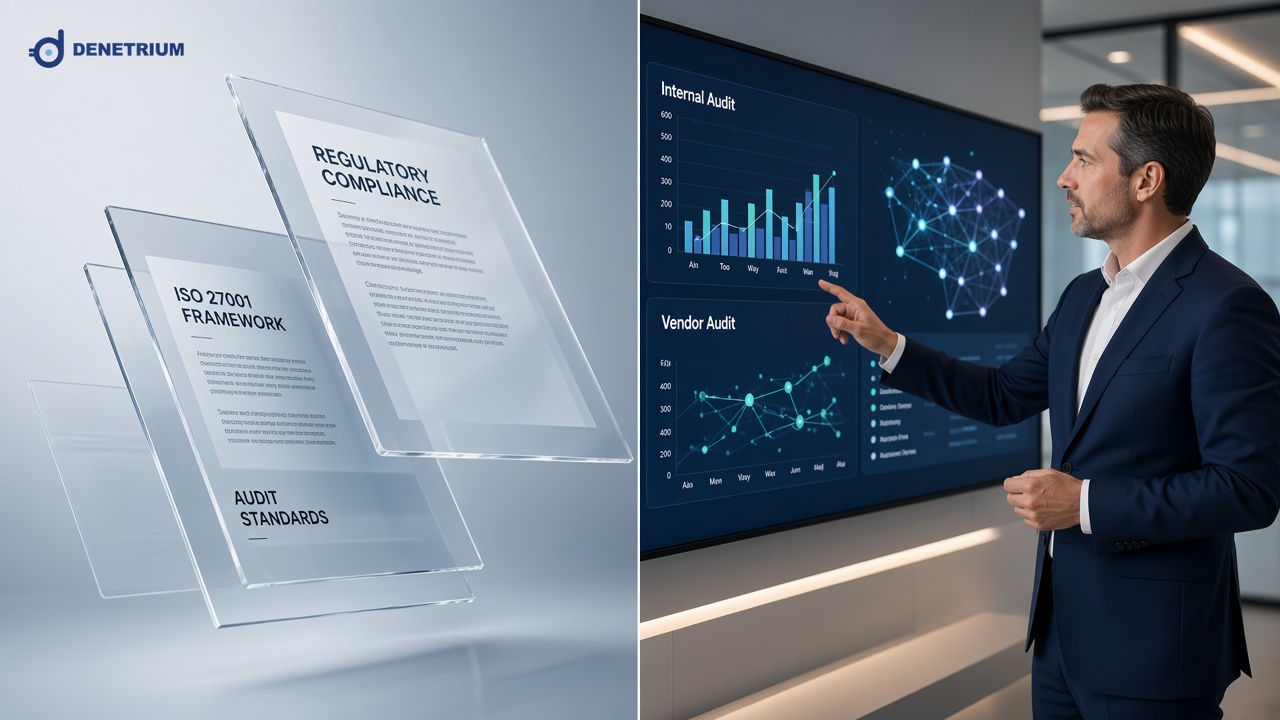
For growing modern enterprises, auditing is no longer an isolated annual event; it has evolved into a strategic foundation for operational resilience, cybersecurity, and enterprise brand equity.
However, as business operations mature, governance complexity escalates rapidly:
IT and Security teams audit ISO 27001 and data protection mandates,
Quality teams execute ISO 9001 operational reviews,
Procurement leads perform mandatory supplier and third-party audits,
Risk and Finance units track findings from statutory and external independent audits.
In most organizations, these efforts remain siloed. Different departments deploy separate spreadsheets, disparate checklists, and unaligned evaluation methodologies. Without a standardized audit framework, operational teams are subjected to redundant audits, burning valuable labor hours while leaving executive leadership with fragmented risk visibility.
The solution lies in enterprise-wide audit program management.
Here is how Denetrium's specialized audit management software unifies multiple compliance frameworks and risk architectures into an integrated operational engine:
1. Flexible Audit Frameworks: Standards, Regulations, and Best Practices
Every audit relies on specific benchmark criteria—international certifications, statutory regulations, or internal standard operating procedures.
The Denetrium Approach: Configure multi-tier audit frameworks inside a single workspace.
Map specific compliance requirement clauses directly to dynamic inspection questions. A single verification checkpoint on the ground can satisfy ISO criteria, legal mandates, and internal SOPs simultaneously.
2. Structuring Audits via Risk and Control Matrices (RCM)
Not all business processes carry equal vulnerability. High-exposure operational units demand rigorous oversight, whereas low-risk routines require lean verification.
The Denetrium Approach: Embed your enterprise Risk and Control Matrix directly into audit programs.
Link operational risks to specific mitigating control activities. When a control fails during a site walkthrough, the system dynamically recalibrates the residual risk score across the enterprise dashboard.
3. Unifying Internal, Vendor, and Independent Audits Under One Roof
Brand integrity extends far beyond headquarters; contract manufacturers, outsourced warehouses, and supply chain vendors dictate delivery quality.
The Denetrium Approach: Manage corporate internal audits, external supplier audits, and remediation tracking from independent audits under a consolidated master audit program.
All streams produce standardized compliance dossiers, providing senior executives with an unvarnished view of operational health.
4. Eliminating Audit Fatigue
Subjecting facility teams to uncoordinated inspections from multiple corporate departments breeds audit fatigue, operational disruption, and administrative friction.
The Denetrium Approach: Integrated audit programming consolidates multi-department requirements into streamlined walkthroughs. Operational safety, quality benchmarks, and IT hygiene are audited simultaneously.
Stop managing mission-critical governance across disconnected spreadsheets. Deploy Denetrium's audit management software and enterprise audit program management framework to command complete visibility over your organizational risk landscape.