
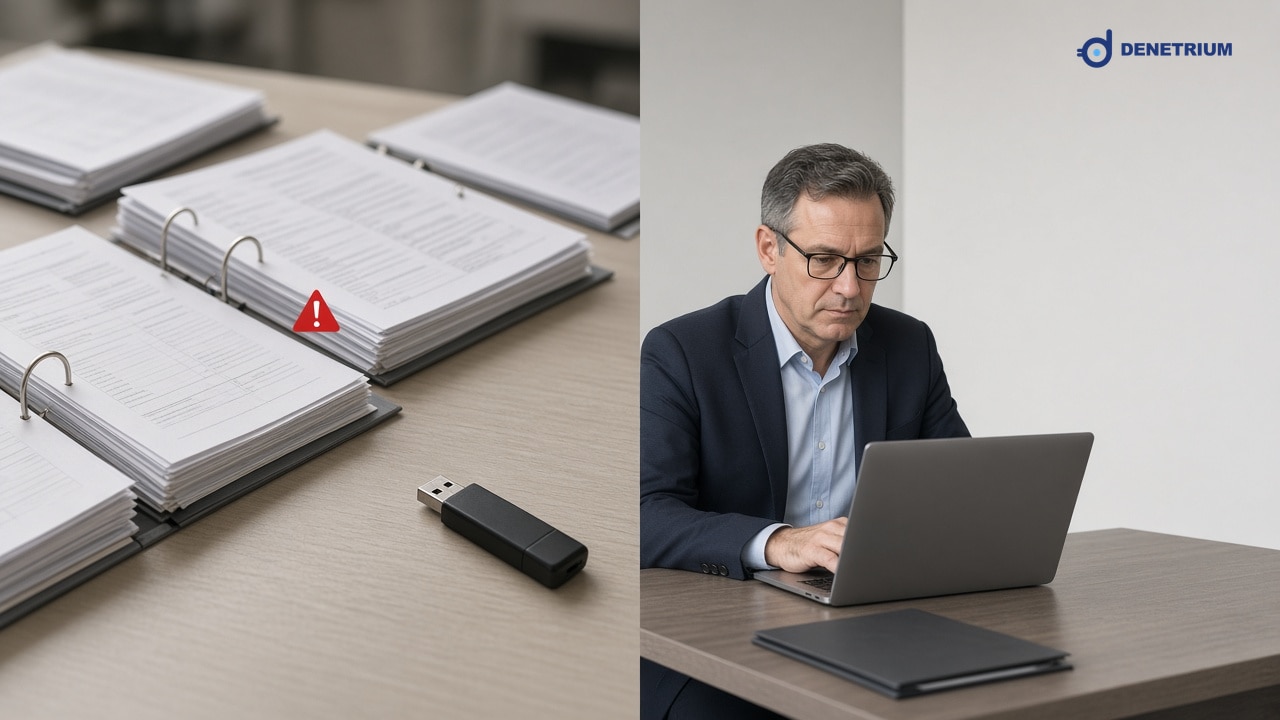
A company’s internal and external audit reports house its most sensitive operational secrets: register cash discrepancies, critical hygiene infractions, supplier vulnerabilities, regulatory liabilities, and personnel misconduct.
Yet in far too many organizations, these high-risk findings live on unencrypted spreadsheets, personal messaging threads, unlocked filing cabinets, or misplaced flash drives. This not only constitutes a severe compliance breach under GDPR / ISO 27001 standards, but also exposes the enterprise to catastrophic intellectual property leaks and corporate reputational damage.
For an audit to carry legal and executive authority, the security, confidentiality, and immutability of the underlying inspection data are non-negotiable.
Here is how Denetrium’s enterprise cloud architecture delivers uncompromised audit security:
1. End-to-End Encrypted Data in Transit and at Rest
No audit data captured on field smartphones or tablets should ever travel exposed.
The Denetrium Approach: Every checklist answer, geotagged coordinate, and inspection photo transmitted between mobile clients and central servers is shielded using end-to-end encryption protocols (SSL/TLS and advanced enterprise cryptographic standards).
Records are stored in secure, multi-tenant cloud environments with encryption-at-rest, guaranteeing that unauthorized third parties cannot intercept or decipher operational files.
2. High-Availability Cloud Storage: Zero Data Loss
Physical audit binders stored in regional offices or local spreadsheets on field laptops remain vulnerable to ransomware, hardware crashes, theft, or physical damage.
The Denetrium Approach: All internal and external audit histories are continuously backed up across resilient, tier-grade enterprise cloud infrastructure. If a field supervisor drops or loses their mobile device on site, all submitted inspection logs and photographic evidence remain intact and instantly accessible in the cloud.
3. Granular Role-Based Access Control (RBAC)
Not every audit finding belongs in front of every employee. A branch supervisor must never access peer fraud audits, and contracted external auditors should not view corporate-wide financial metrics.
The Denetrium Approach: Built-in Role-Based Access Control (RBAC) establishes strict data partitions. Location managers only see assigned action tickets; regional directors access their assigned districts; executive leadership commands aggregate visibility. Independent third-party auditors are provisioned restricted, time-bounded access strictly limited to their audit scope.
4. Immutable Audit Trails: Tamper-Proof Accountability
Nothing undermines an audit faster than retroactive data tampering: “Who modified this compliance score?” or “Who deleted that defect photo?”
The Denetrium Approach: Denetrium maintains an unalterable audit trail that logs every user action, status transition, timestamp, and photograph. Once an inspection is sealed, data cannot be quietly overwritten or manipulated, providing indisputable evidence during statutory inquiries and external certification reviews.
Do not leave your most critical operational liabilities exposed on unencrypted files. Deploy Denetrium to secure your internal and external audit data within a certified, end-to-end encrypted cloud ecosystem.